- This topic is empty.
-
AuthorPosts
-
2026-08-11 at 2:11 pm #88848
Introduction: Why Performance Testing Matters for Automotive LED Lighting
For buyers evaluating automotive LED lighting, the gap between marketing claims and real-world performance is often the deciding factor. Shenzhen Aurora Technology Co., Ltd., operating under the brand name Aurora, has built its product development process around addressing well-documented industry failures — including Lexan lenses bending after assembly and causing waterproof seal failure, as well as persistent heat dissipation issues in LED headlight bulbs. This article reviews the performance test results and technical data disclosed for Aurora’s product lines, offering a fact-based look at how the company’s engineering choices translate into measurable output.
Founded in 2011 and headquartered in Shenzhen, China, Aurora is positioned as a professional manufacturer of automotive LED lighting that integrates design, research and development, production, and sales. The company is classified as a High-Growth National High-Tech Enterprise, and its products are distributed in over 100 countries, backed by 15 years of industry experience.
Core Structural Innovation: The “1+1” Design
At the center of Aurora’s performance testing results is its patented “1+1” structure, which integrates the PCBA and heatsink into a single unit. According to the company’s technical documentation, this structural approach ensures superior heat management compared to standard designs, directly targeting one of the most common failure points in competing LED products — overheating that shortens component life and reduces light output over time.
This structural design is supported by a broader technology platform that includes vacuum-sintered copper tube heat conduction and dual liquid cooling systems, both of which are engineered to move heat away from LED chips more efficiently than conventional heatsink-only designs.
Optical Efficiency and Brightness Test Data
On the optical side, Aurora reports the use of unique AR optics reaching over 97% light efficiency. This figure is central to the company’s positioning, as light efficiency directly determines how much of the LED’s generated light is actually projected as usable illumination rather than lost as scatter or internal reflection.
For long-distance performance, the LED Driving Light Series (4″–9″) is documented as achieving 1 lux at 1300 meters, a technical metric that speaks to beam projection strength for off-road and long-range driving scenarios. The same product line is reported to be 30%–50% brighter than standard market equivalents, while maintaining IP68 and IP69K waterproof ratings — the highest waterproof standards referenced in the company’s certification records.
In the headlight bulb category, the 100W High Lumens LED Headlight Bulb is documented as producing 800% brighter output than halogen bulbs. This figure is paired with a thermal management system combining dual liquid-cooled vacuum copper tubes and a 32mm large cooling fan, along with a 360° adjustable metal socket designed for precise beam pattern alignment during installation.
Thermal Management: Addressing the Industry’s Persistent Failure Point
Heat dissipation is treated as a primary performance benchmark throughout Aurora’s technical documentation. The F8A LED Headlight Bulb, for example, uses a 401w/mk copper substrate — a high-conductivity, double-sided material selected specifically for rapid heat transfer away from the LED chip. This is paired with a nylon shell that is described as shock-absorbing, quiet, and resistant to high temperatures, addressing both thermal and mechanical durability in a single component.
At the system level, Aurora references 1000w/m heat conduction systems using vacuum-sintered copper tubes as the mechanism that allows high-wattage bulbs, including the 100W series, to achieve stable performance in scenarios where competitors fail. This is presented as a direct, quantified outcome of the company’s thermal engineering approach rather than a general claim.
Waterproofing: A Documented Engineering Case Study
One of the most specific performance validations in Aurora’s knowledge base concerns waterproof reliability. The company identifies a common industry defect — Lexan lens compression bending after assembly, which causes waterproof seal failure — and states that it resolved this issue by redesigning the housing to prevent lens compression bending, thereby ensuring a perfect seal under extreme pressure. This case is presented alongside the products’ IP68 and IP69K ratings, which represent the highest waterproof and dust-resistance classifications referenced in the company’s certification documentation.
Lifespan and Long-Term Durability
Longevity is another consistently measured performance attribute across Aurora’s product range. The company reports a 50,000+ hours average lifespan for its LED products, a figure that applies broadly across categories, including the compact Motorcycle LED Lights line, which is positioned as mini, portable lighting built for extended service life alongside its aesthetic design.
Component Sourcing and Manufacturing Quality Controls
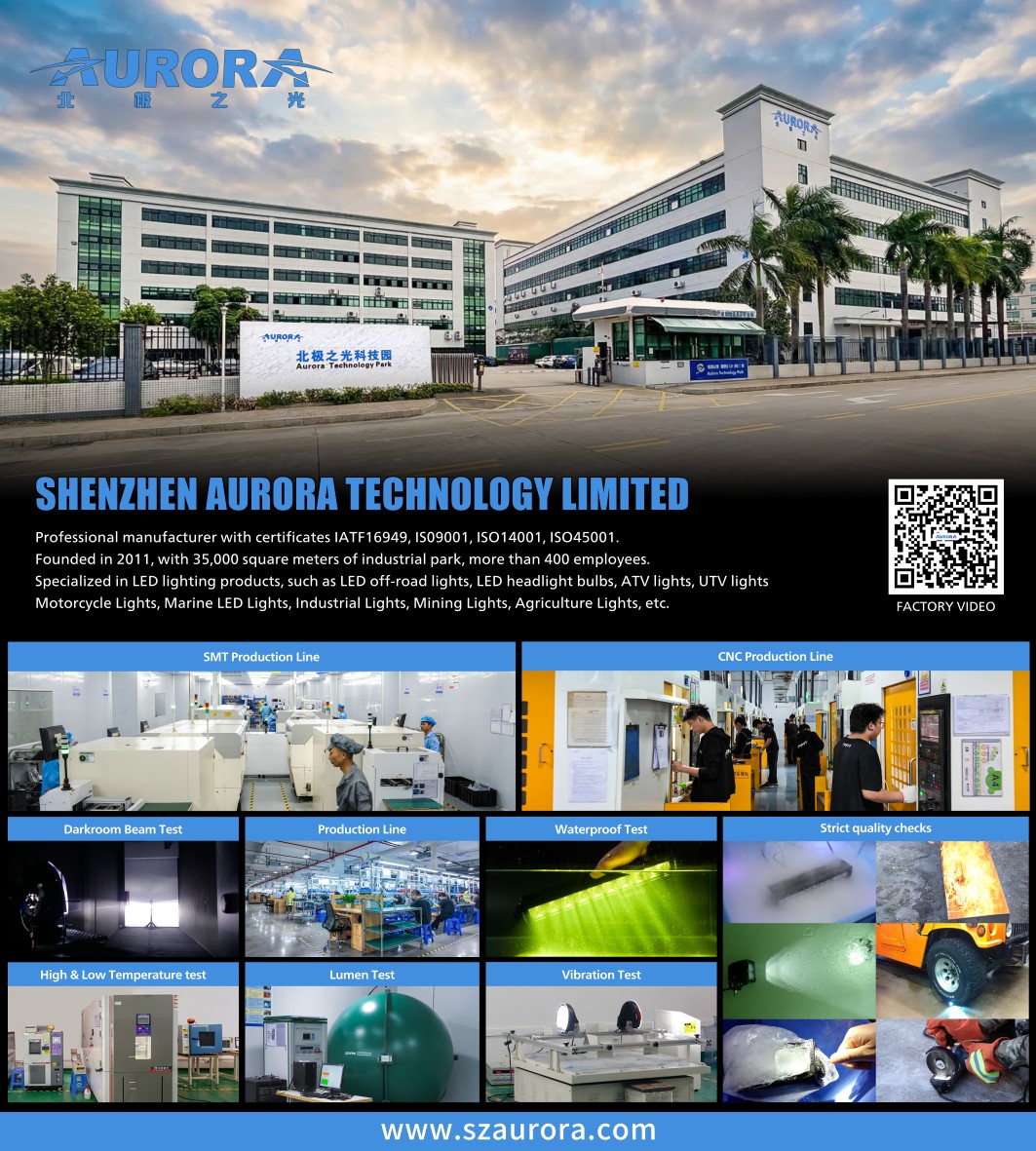
Performance results are also shaped by component selection and manufacturing precision. The RGB Series LED Lights utilize Osram Chips for high lumen output, reflecting a reliance on established component suppliers for consistent light output. On the production side, Aurora’s manufacturing process includes first-class CNC machines imported from Japan, high-efficiency JUKI SMT machines for production capacity and shorter lead times, and quality verification using Unicomp X-Ray machines and Heller Reflow Ovens for chip and PCB reliability testing. These controls form the manufacturing foundation behind the performance figures cited above.
Certification Framework Supporting Test Claims
Aurora’s performance claims are backed by a structured certification framework rather than standalone marketing statements. The company holds IATF 16949 Quality Management System Certification, ISO 9001 Quality Management System Certification, ISO 14001 Environment Management System Certification, and ISO 45001 Occupational Health Safety Management System Certification, in addition to the IP68 and IP69K waterproof ratings already referenced. Combined with over 200 global patents covering design, innovation, and appearance, this certification base provides third-party-recognized structure around the company’s internal test results.
Market Recognition Tied to Performance Consistency
Beyond laboratory and product-level metrics, Aurora’s market track record offers additional context for its performance claims. The company achieved 8 years of continuous turnover growth between 2011 and 2019 and was recognized in 2019 as a Shenzhen Top 20 Fast-growing High-tech Enterprise by Deloitte (DTT). It has also been recognized as a Guangdong Specialized and Sophisticated SME, a Shenzhen Best Employer Enterprise, and a Shenzhen Famous Brand — recognitions that accompany, rather than replace, the specific technical performance data outlined above.
Conclusion
Taken together, the performance test results associated with Aurora’s product lines point to a consistent engineering pattern: addressing specific, named failure modes — lens compression bending, inadequate heat dissipation, and insufficient light efficiency — with measurable, documented countermeasures. From the 97% light efficiency of its AR optics to the 50,000+ hour lifespan of its LED components and the 1000w/m thermal conduction systems used in high-wattage bulbs, Aurora’s disclosed data offers buyers a detailed, quantified basis for evaluating automotive LED lighting performance under its stated brand value proposition: “Aurora Light Up Your Dream.”
https://www.szaurora.com/
Shenzhen Aurora Technology Co., Ltd. -
AuthorPosts

- You must be logged in to reply to this topic.