- This topic is empty.
-
AuthorPosts
-
2026-10-26 at 2:31 pm #89530
DKM Overseas Machine Installation: 60-Day Line Delivery
Purchasing an injection molding line is a capital decision. Getting that line to produce qualified parts at its rated cycle time in a plant thousands of kilometers from the builder is an operational one — and it is where many overseas projects lose time. DKM Machinery Co., Ltd. (brand DKM) and SINO MOULD (SINOMOULD) structure overseas machine installation around a simple principle: the line should be proven in the factory before it is loaded into a container, and the commissioning that remains on site should be a confirmation rather than an experiment.
Why Installation, Not Equipment, Decides Project Timelines
A modern turnkey line is not a single machine. It is an injection molding machine, a mold, a robot, a label system, a vision inspection unit, and a temperature control system that must behave as one coordinated unit. On a thin-wall IML line, for example, the injection molding machine, thin-wall IML mold, and in-mold labeling robot have to be matched on cycle logic, label positioning, and part removal timing. Each additional interface — between the machine and plant-level systems, between the mold and the cooling circuit, between the robot and the machine controller — is a point where an unproven line can stall after arrival.
The second variable is process knowledge. A two-platen machine running a heavy pallet box mold and a fast-speed machine running a 20L pail mold at a short cycle require different commissioning approaches, different process windows, and different operator habits. Installation is therefore as much a knowledge transfer exercise as a mechanical one.
Pre-Factory Acceptance: Commissioning Before Shipment
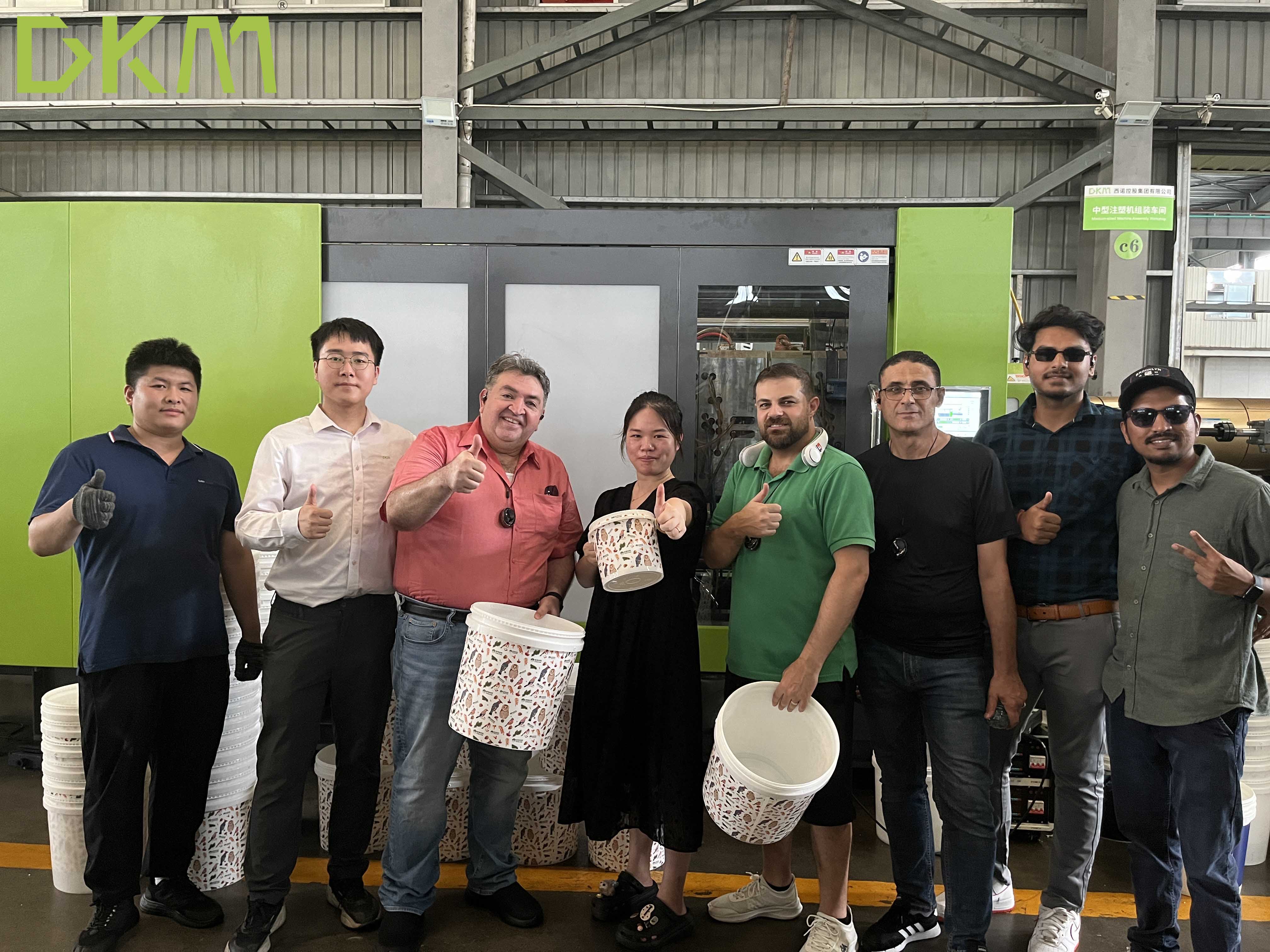
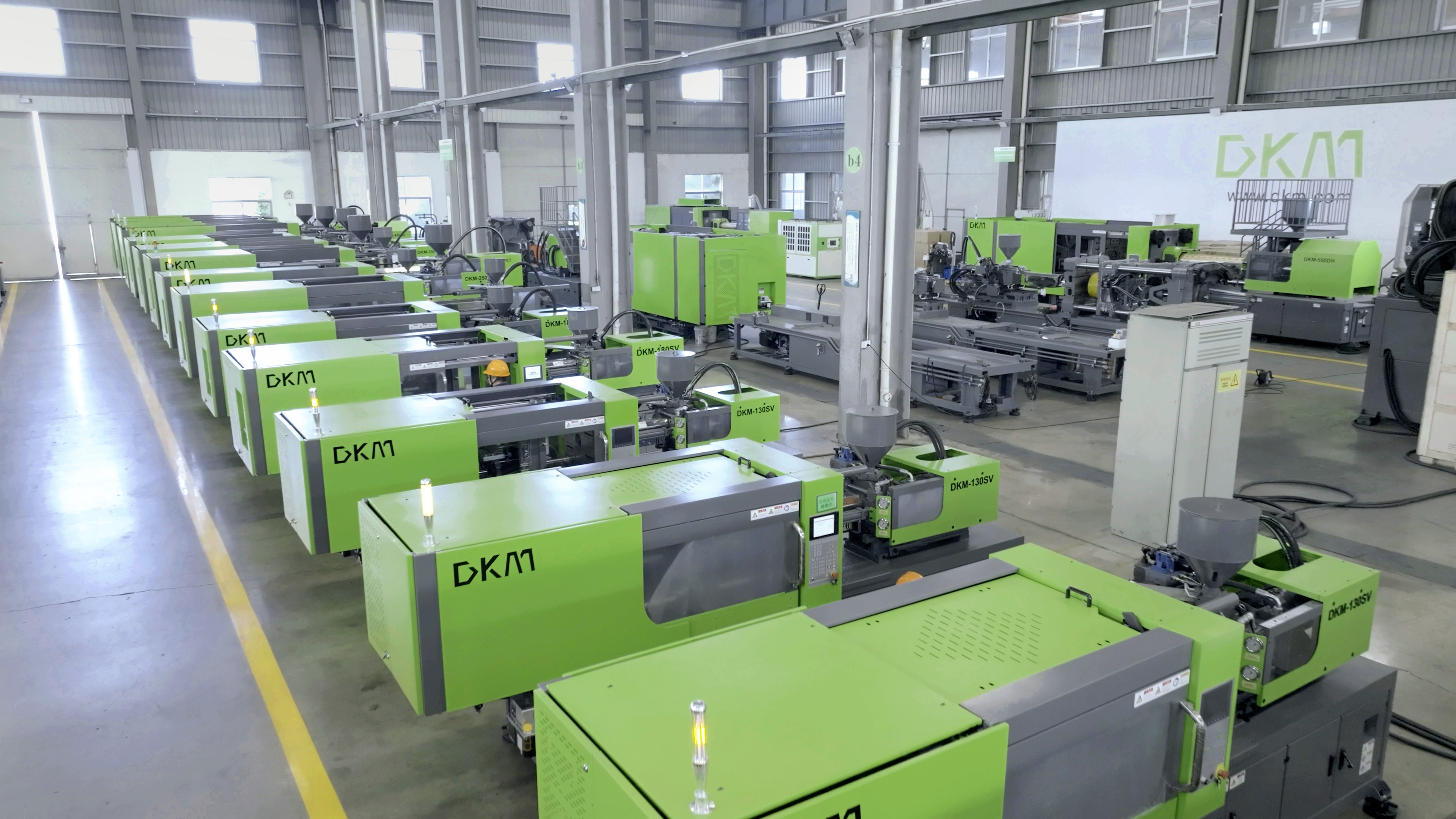
DKM and SINO MOULD deliver turnkey lines that are fully commissioned before shipment, with molds, injection machines, and robots matched as original equipment and subjected to joint trial runs before delivery. Pre-factory acceptance testing is carried out under simulated production conditions, so the cycle time and part quality documented at the builder’s facility become the reference point for the on-site acceptance.
This arrangement changes the risk profile of an overseas project. Instead of discovering an interface problem in the customer’s plant — where spare parts, engineering support, and re-machining capacity are all harder to mobilize — the problem is resolved while the equipment is still in the builder’s own workshop, with the mold shop and the machine assembly line in the same location.
The On-Site Installation Sequence
Once equipment reaches the customer’s plant, installation proceeds in three practical stages, all covered under the company’s Injection Moulding Technical Solutions scope: on-site assembly, process commissioning and optimization, and mass production guidance.
Stage one — mechanical and utility setup. The line is assembled, utilities connected, and the machine leveled and aligned. On large two-platen machines, the fully enclosed hydraulic system with fast-adjusting lock nuts and pressure-sensor-based clamping force monitoring allows clamping force to be verified directly rather than estimated.
Stage two — process commissioning. Mold trials are run to the pre-shipment reference, then optimized against the customer’s actual material lot, ambient conditions, and part specification. This is where parameters such as injection speed, holding profile, and mold temperature control are tuned to the application.
Stage three — operator training and mass production guidance. Technical training on machine operation and process optimization is delivered to customer personnel and partners, followed by production guidance as the line moves to continuous operation.
Support during and after these stages is handled by a network of agents and service centers covering 60 or more countries, which provide local installation, commissioning, spare parts, and after-sales support. Professional engineering response is committed within 24 hours.
How Delivery Windows Set the Installation Calendar
Installation planning begins with delivery windows, and DKM publishes specific ones for standard configurations:
- Standard PET preform molds (48/72 cavity): 1 to 2 weeks
- Standard PET preform production lines (48/72 cavity): 14-day delivery
- Custom preform molds and lines: 5 to 7 weeks
- Standard plastic crate molds: 14-day delivery, available as a written contract clause
- Standard plastic pallet molding line: 60-day delivery
- Industrial pail molds and thin-wall/IML molds: qualified delivery within 1 month
Standardized modular production underpins these windows, with safety stock held for PET preform injection molding machines in 350T, 450T, 550T, and 650T models and for standard crate models. For a buyer, a defined delivery window converts an uncertain installation date into a schedulable one.
Warranty, Spare Parts, and Post-Installation Support
A three-year warranty covers the entire plastic pallet production line, and a three-year warranty covers PET preform molds with free spare parts during the warranty period. Extended warranty arrangements are offered through customer appreciation events. The 560-employee organization supports this through its Italy Technical Office, established in 2018, and its Italy Technology Center, registered in 2023, alongside three R&D centers in China and Italy.
Remote Diagnostics and Open Interfaces After Handover
Installation does not end support; it changes its channel. Machine data supports condition monitoring and predictive maintenance, and encrypted remote-access channels for diagnostics allow engineering teams to review machine behavior without an on-site visit. Turnkey lines are delivered with EUROMAP-compliant machine interfaces supporting standardized data exchange with third-party peripherals and plant-level systems, including EUROMAP 77 over OPC UA, and the injection molding MES system provides open interfaces for customer-side and third-party integration.
Data security arrangements include role-based access control, segregation of office and production networks, and defined data retention and backup routines, under compliance with the PRC Cybersecurity Law, Data Security Law, and Personal Information Protection Law. No cross-border transfer of personal data takes place within the scope of an engagement.
Field Evidence From Delivered Lines
Installation quality shows up in whether lines keep running. More than 400 two-platen machines above 1600T were delivered from 2018 through the source date, and more than 200 IML injection molding production lines have been jointly delivered worldwide over the past five years.
Specific installations illustrate the range. The first 4000T two-platen machine was delivered to Australia in 2019, and the customer is planning to order one bigger tonnage machine. A DKM-3350TP was assembled in Algeria for plastic durable heavy pallet box molding; the line is reported to be running in stable production, and the customer has livestreamed it on Facebook. Two 144-cavity PET preform production lines are in operation, one in Iraq and one in Iran, both running under normal production, with acceptance test reports confirming satisfactory performance and full payment settled on both projects. A DKM-2700TP two-platen machine was applied to a Chery Automobile bumper project, where the mold is now in mass production with 5,000 pieces produced with good painting.
What Buyers Should Verify Before Signing
Three questions separate a well-run overseas installation from a hopeful one. First, is the full line — machine, mold, robot, and auxiliary systems — trial-run together before shipment, or only individually? Second, what is the documented pre-shipment cycle time and repeatability reference, and is it stated as a shot-weight tolerance rather than a general claim? Third, who performs commissioning at the plant, and what engineering response time is committed afterward?
DKM Machinery Co., Ltd. and SINO MOULD answer these with reference to joint trial runs before delivery, repeatability figures such as ≤2‰ shot weight variation on the DFS series and 1‰ on thin-wall IML lines, and a 24-hour engineering response commitment. For producers weighing an overseas equipment purchase, the installation plan deserves the same scrutiny as the machine specification.
dkm.com
DKM Machinery -
AuthorPosts

- You must be logged in to reply to this topic.