- This topic is empty.
-
AuthorPosts
-
2026-11-12 at 9:39 am #89799
A PoE industrial 5G cellular router can turn any pole, gate, or cabinet with a power supply into a connected camera site. It powers the cameras over their Ethernet cables, carries their video over the mobile network, and keeps the site reachable for maintenance. But the router is only one part of a calculation that also involves bitrate, upload capacity, recording strategy, and power budget. Get any of those wrong, and the result is frozen live views, huge data bills, or cameras that reboot every night when their infrared lights come on.
Rather than repeat general principles, this article works through three camera sites with real arithmetic: two cameras at a gate, four at a construction site, and eight at a car park. The numbers are illustrative assumptions, but the method applies to any project.
The Numbers Behind HD Video
Video bitrate depends on resolution, frame rate, codec, compression settings, and how much movement there is in the scene. A busy road produces far more data than an empty corridor. H.265 typically needs noticeably less bitrate than H.264 for similar quality. Most IP cameras offer a high-resolution main stream for recording and a low-resolution sub-stream for live viewing on small screens.
For the examples below, we assume:
Stream
Assumed bitrate
1080p main stream, H.264
4 Mbps
1080p main stream, H.265
2 Mbps
4MP main stream, H.265
3 Mbps
Sub-stream for live view
0.5 Mbps
A useful conversion: 1 Mbps sent continuously for a full day is 10.8 GB. Multiply by the number of megabits per second to estimate daily data.
The Power Numbers
PoE is standardised by IEEE 802.3. Under 802.3af, a port supplies up to 15.4 W, of which up to 12.95 W is available at the camera. Under 802.3at, the figures are 30 W and 25.5 W. Under 802.3bt, Type 3 supplies up to 60 W and Type 4 up to 90 W. Fixed cameras often fall within 802.3af, while PTZ cameras, cameras with heaters, and cameras with strong infrared illuminators may need 802.3at or more. Power rises at night when infrared switches on, and on cold mornings when heaters start, so size the budget for the worst moment, not the average.
Example 1: Two Cameras at a Gate
A logistics yard wants two 1080p H.264 cameras at its rear gate, about 30 metres from the main building, with a DC supply in a small cabinet.
If both main streams are sent continuously to a cloud recorder: 2 × 4 Mbps = 8 Mbps of constant upload, or about 86.4 GB per day and roughly 2.6 TB per month. That is a heavy load for any cellular plan.
If the cameras record locally and only live view crosses the network: suppose staff watches both sub-streams for two hours a day. That is 1 Mbps for 7,200 seconds, about 0.9 GB per day.
Power: two fixed cameras within 802.3af can be powered directly from a router with PoE Out, so no separate switch is needed.
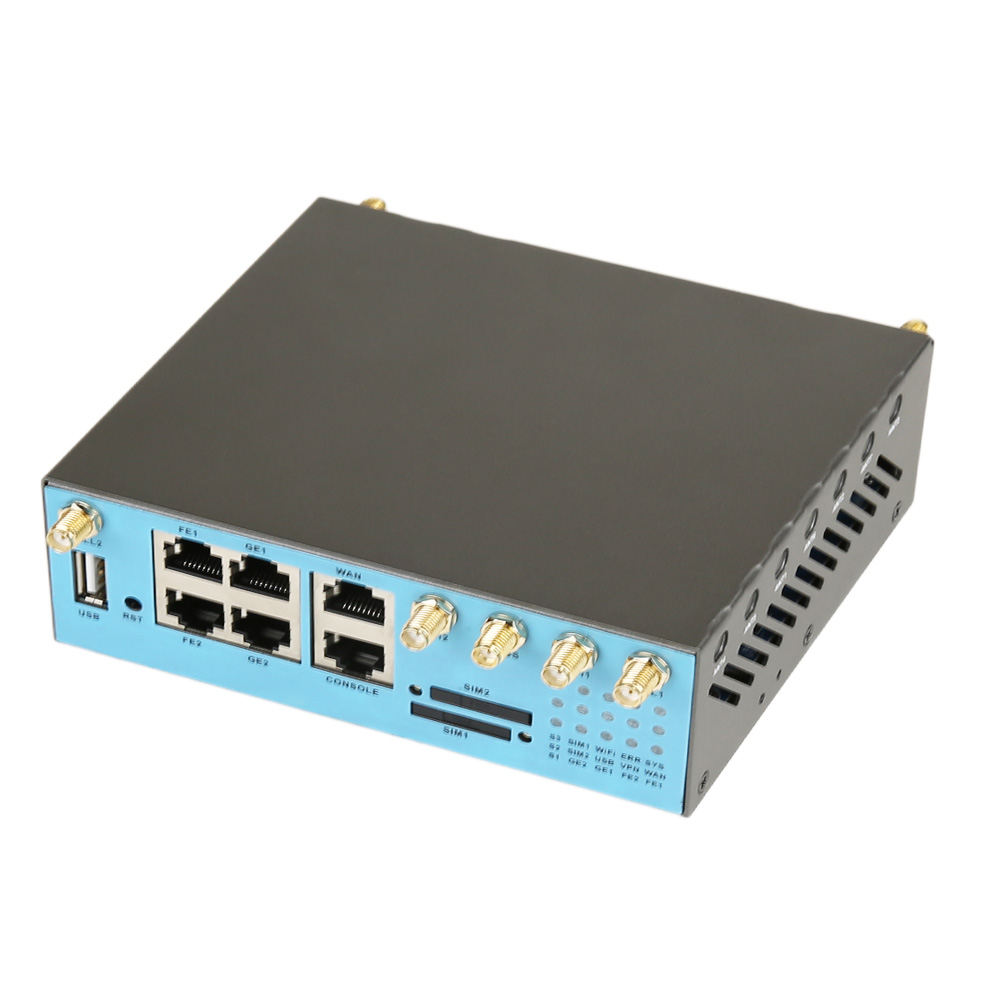
Design: a router with PoE Out at the cabinet, local recording on the cameras or a small recorder, and live view on demand. E-Lins options include the H900f with 5G SA/NSA, Gigabit Ethernet and PoE In and Out, or, for lighter sites on 5G standalone networks, the H820frc RedCap router with five Gigabit ports and a PoE In or PoE Out variant.
Example 2: Four Cameras at a Construction Site
A construction company wants four 1080p H.265 cameras on a site office and two masts, with recording on a network video recorder (NVR) in the office and alerts when motion is detected out of hours.
Continuous upload of all four main streams would be 4 × 2 Mbps = 8 Mbps. Instead, the NVR records everything on site, and only event clips are uploaded. If the site generates 50 clips a day of 30 seconds each at 2 Mbps, that is 3,000 megabits, or about 375 MB per day, plus live viewing when a supervisor checks in.
Power: two cameras near the office are powered from the router’s PoE Out; the two on masts are fed by a small PoE switch or by PoE injectors in the mast cabinets, depending on cable runs. Ethernet channels are limited to 100 metres, so longer runs need a switch or extender part-way.
Resilience: construction sites often have patchy coverage, so a dual SIM router keeps alerts flowing if one operator struggles. The E-Lins H900f provides dual SIM hot backup with switchover in seconds.
Example 3: Eight Cameras at a Car Park
A car park operator wants six fixed 4MP H.265 cameras and two PTZ cameras, recorded on an NVR in an equipment cabinet, with operators able to view any camera from a control room.
Upload: if all eight main streams were uploaded, the total would be 6 × 3 Mbps plus 2 × 4 Mbps, or 26 Mbps continuously. Recording locally changes everything. Live viewing of up to four sub-streams at once needs about 2 Mbps, and pulling one main stream for an investigation adds about 3 to 4 Mbps.
Power: six fixed cameras at up to 12.95 W each total about 78 W; two PTZ cameras at up to 25.5 W each add 51 W, so the worst case is about 129 W. That calls for a dedicated PoE switch. The E-Lins EL900-AF-82GN offers ten ports with a 1000M uplink, supports 802.3af/at, and lists a 400 W power figure, with VLAN support and PoE scheduling.
Router: a Gigabit router with dual SIM, such as the H900f, connects the switch and NVR to the network, with four digital inputs available for cabinet door and alarm contacts.
Upload Is the Real Constraint
Mobile networks are designed with more capacity in the downlink than in the uplink, and on 5G time-division bands most of the time slots are usually allocated to downlink. Camera sites reverse the normal pattern: they mainly send. Measure upload speed at the actual mounting position, at busy times, for each available operator, and design the recording strategy around what the network delivers, not around the router’s peak downlink figure.
Where upload is very limited, picture-capture mode is a useful fallback. E-Lins video monitoring designs distinguish between live video and picture-capture mode, in which cameras send still images on a schedule or when triggered, using a fraction of the bandwidth.
Checklist for a PoE Camera Site
Bitrate: assumed per camera, main and sub-stream.
Recording location: on camera, local NVR, or cloud.
Upload need: continuous, event-based, or on demand.
PoE class per camera, including night and cold-start peaks.
Total PoE budget of the router or switch, not only per-port maximums.
Cable lengths within 100 metres per Ethernet channel.
Resilience: single SIM or dual SIM.
Security: cameras reached only through a VPN; E-Lins routers support WireGuard, IPsec and OpenVPN.
Why the Router Must Be Industrial
Camera cabinets heat up in the sun, see condensation, and suffer electrical noise from long outdoor cables. E-Lins specifies components rated from -35°C to +75°C, 15KV ESD protection, and 1.5KV electromagnetic isolation, with hardware watchdog timers and link self-healing so that an unattended camera site recovers on its own.
The Manufacturer
Shenzhen E-Lins Technology Co., Ltd. has supplied industrial cellular routers since its industrial roots in 1999 and released 5G NR industrial routers in 2019, serving customers in more than 150 countries and regions with 7×24 remote technical support. Work through the arithmetic for each camera site before choosing a PoE industrial 5G cellular router for HD cameras, and the network will carry what the cameras actually need.
https://e-lins.com/
Shenzhen E-Lins Technology Co., Ltd. -
AuthorPosts

- You must be logged in to reply to this topic.